
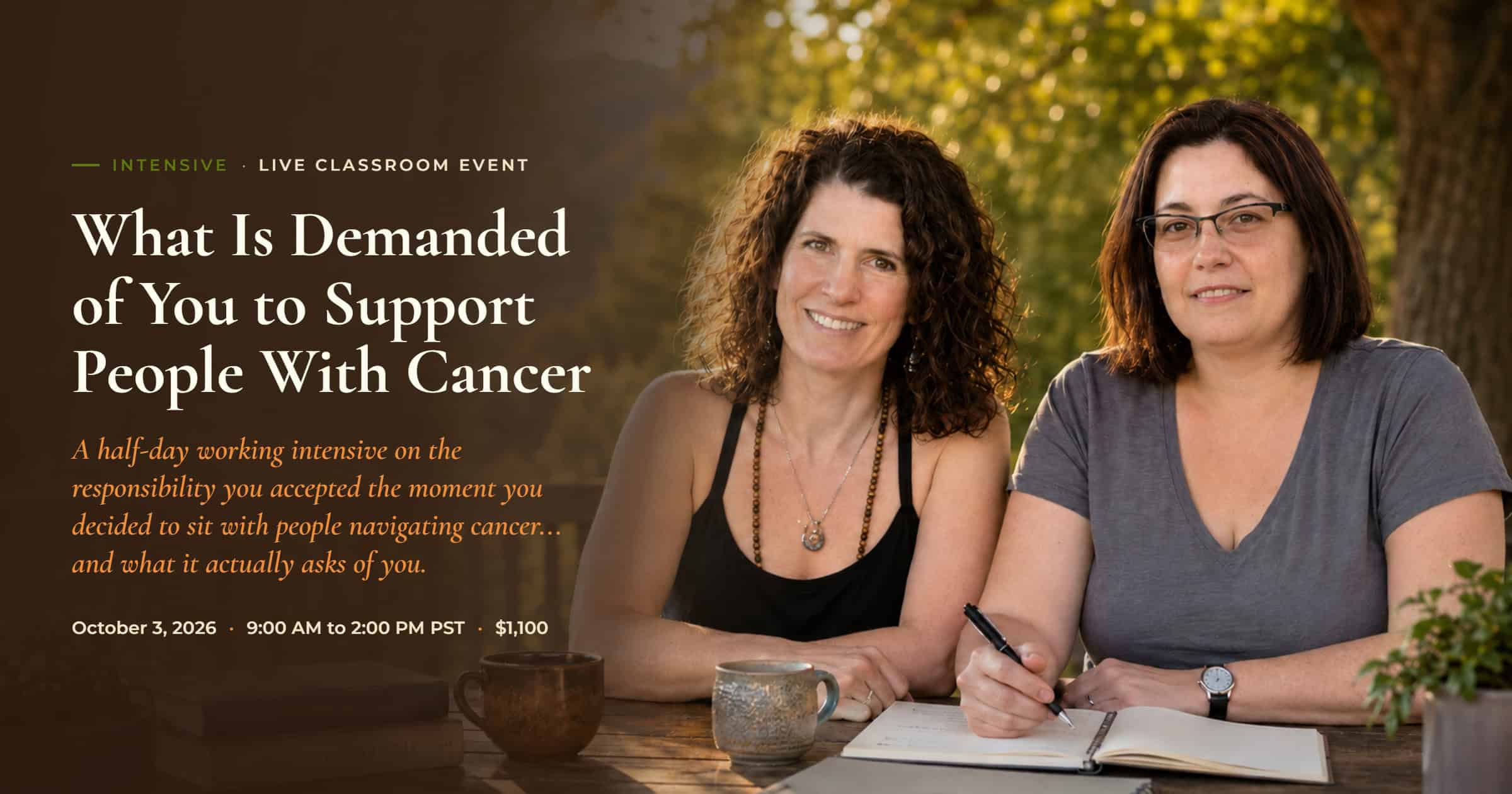
A half-day working intensive on the responsibility you accepted the moment you decided to sit with people navigating cancer…and what it actually asks of you.
October 3, 2026 · 9:00 AM to 2:00 PM PST · $1,100
Nobody fails this work because they didn't study hard enough...
They fail it in quieter ways. They absorb a client's fear and hand it back doubled. They rise and fall with every scan, every marker, every shift in the plan, until the client is steadying them instead of the other way around. They carry outcomes that were never theirs to carry, and they burn out or blur out, and the client feels it long before the practitioner names it.
When someone with cancer sits across from you, they are not just asking for information. They are asking whether you have the capacity to stay steady while their world is moving. Your steadiness is part of the work. Your clarity is part of the work. Your examined self is part of the work.
Certified isn't the same as ready. This intensive is where we get honest about the difference.
What We're Covering
Steadiness As A Skill. Emotional maturity in complex cases is trainable, not temperamental. How to stay anchored when the news changes, why your nervous system state shows up in the room whether you name it or not, and what it takes to be a stabilizing presence instead of another source of turbulence.
The Discipline Behind The Role. Cancer does not exist in isolation, and neither can your education. We'll map the study terrain this work demands… metabolism, physiology, labs, conventional and integrative oncology, sleep, movement, trauma, behavior change… and how to build a learning practice that keeps pace with an evolving field without pretending you'll ever know everything. Intellectual honesty, including a confident "I don't know, but I'll help you find out," is a feature of this role, not a failure of it.
Organizing Complexity. Clients arrive carrying fear, podcasts, internet rabbit holes, and advice from everyone they've ever met. Your job is not to dismiss any of it. Your job is to help them separate urgency from importance and evidence from opinion, so decisions get made from clarity instead of panic.
Listening Underneath The Story. Most people hear symptoms. You will learn to hear patterns… exhaustion behind determination, grief behind anger, fear behind control. Knowing when a client needs education and when they need a witness is a clinical skill, and we'll work it like one.
Boundaries, Ownership, And Agency. You cannot rescue people, and you cannot want their progress more than they do. The work belongs to the client. Your role is to help them carry it, not to carry it for them. We'll draw the line between support and over-functioning, and look at what your own unexamined patterns do to a case when that line blurs. The hardest variable in the case is you.
Courage And Consistency. Sometimes the work is slowing someone down mid-search for the next miracle. Sometimes it's naming a belief that stopped serving them. Sometimes it's sitting with someone while they process the worst news of their life. And underneath all of it, trust is built by the unglamorous things… following through, remembering, preparing, showing up again.
The Language For The Hard Moments. Practitioners don't fail these conversations from lack of understanding. They fail them from not having words ready. We'll work through a language bank for the courage moments… how to slow someone down without dismissing them, how to name a belief that stopped serving them, how to decline a question outside your role without abandoning the person asking it.
Live Practice. This is not a listening session. You will work the skills in the room… short scenario rounds where you take a turn holding one of these conversations while it's still safe to get it wrong. Steadiness under real conditions is built through repetition, and this is where the repetitions start.
What You Do With What You're Carrying. Everyone teaches the boundary. Almost nobody teaches the release. We'll close with a post-session decompression practice for the weight this work leaves behind at 4 PM on a hard day, so a boundary becomes something you practice instead of something you recite.
How The Day Is Structured
You'll complete a short reflective inventory before October 3, so the live hours start deep instead of warming up. In the room, teaching and live practice alternate through the day. And before you leave, you'll complete a scored self-assessment across the core capacities of this work… steadiness, listening, boundaries, curiosity, consistency, and self-examination… identify your lowest area, and build a 90-day improvement commitment around it. You will not leave with notes. You will leave with a starting point.
Why This One Runs A Half Day
This is foundational character and capacity work, and it doesn't compress. It is also the doorway to the heavier conversations coming later in the classroom, including death and dying conversations and trauma-informed advocacy. Those sessions assume you've done this one first. We are building the floor those rooms will stand on.
Who This Is For
Non-prescribing practitioners supporting people with cancer who are serious about this work as a responsibility, not a title. If you've ever left a session carrying something that wasn't yours, second-guessed whether you're actually ready for the cases in front of you, or wondered why your best information isn't landing, this room was built for you.
What You'll Walk Away With
The Advocacy Readiness Workbook, yours to keep and reuse. Inside it: your scored self-assessment and 90-day improvement commitment, the language bank for the hard moments, a guide to the common pitfalls of this work, your reflective inventory, the post-session decompression practice, and a curated resource guide for building the study discipline this role demands.
Beyond the workbook, you'll leave with lived repetitions from the practice rounds, a clear-eyed picture of what this role asks across mind, skill, and character, and standing eligibility for the advanced conversations this intensive unlocks.
And one more thing, which we'll name plainly at the end of the day. This work is too complex, and too heavy, to carry alone. The practitioners who last in it build their 90-day commitments inside a community that holds them to it. We'll show you what that looks like.
Taught By Someone Who Has Sat In Both Chairs
Most practitioners know Jen Harbour as the steady presence in the case room. Before any of that, she was the person receiving the diagnosis.
Jen's path into this work began with her own breast cancer diagnosis, which means she knows the room this intensive prepares you for from the other side of the table. She knows what a practitioner's fear feels like when it lands on a client, and she knows what steadiness feels like when it holds. That knowledge shaped everything she built afterward.
And she built deliberately. A Certified Medical Assistant who has worked alongside metabolically trained physicians on both coasts, Jen has served over 500 clients around the world. She then went where most clinical training never goes… certifications in Emotional Freedom Technique and Thought Field Therapy, Autonomic Response Testing with Dr. Dietrich Klinghardt, training in Internal Family Systems, and Level 1 Trauma Specialist certification through the Arizona Trauma Institute. She holds a seat on the Fascia World Congress and co-authored the Metabolic Healing Kitchen with Dr. Frank Christopher Duhon.
That stack of training isn't decoration. It is the exact terrain this intensive covers… the nervous system, the emotional load, the unexamined patterns that walk into every session with you. Jen has spent years doing this work on herself and with hundreds of clients in some of the heaviest seasons of their lives.
You're not learning steadiness from someone who read about it. You're learning it from someone who needed it, built it, and now teaches it.